

Quartz glass consists solely of silicon dioxide, and the currently widely accepted structural model is the continuous random network (CRN) model. In this model, Si and O atoms form nearly perfect three-dimensional Si-O tetrahedral structures. A schematic diagram illustrating the planar microstructure of high-purity quartz glass and its spatial arrangement is shown in the figure. The Si-O chemical bonds have high bond energy and short bond length, resulting in a highly compact spatial structure. Due to the integrity and tightness of its microscopic network structure, high-purity quartz glass exhibits a series of excellent and unique comprehensive properties, such as superior optical transmittance, radiation resistance, thermal stability, and chemical stability.
The history of quartz glass preparation dates back to 1839, when the Frenchman Gandin successfully produced an opaque piece of quartz glass by melting quartz sand with a hydrogen-oxygen flame. Since then, countries around the world have actively engaged in research and development of quartz glass manufacturing technologies. New production methods have emerged, manufacturing processes have continuously improved, and the industry has experienced rapid growth.

The gas refining method involves using a hydrogen-oxygen flame to melt natural quartz, and then gradually depositing the molten material on the surface of a quartz glass target to obtain a quartz glass ingot. The raw materials for both the electric melting method and the gas refining method are quartz sand. High-purity quartz glass has very strict requirements for quartz sand, but the global sources of high-purity quartz ore are mainly located in countries such as the United States, Norway, and Australia. China is a major consumer of high-purity quartz sand, but the sources of high-purity quartz ore mainly rely on imports. The high degree of reliance on raw material imports may affect the stability of industrial development. Therefore, developing the preparation process for synthetic quartz glass is particularly important.
The preparation process of synthetic quartz glass mainly includes chemical vapor deposition (Chemical Vapor Deposition, CVD), plasma chemical vapor deposition (PCVD), indirect chemical vapor deposition method and sol-gel method.
Quartz glass can also be classified into opaque quartz glass and transparent quartz glass based on its transparency:
Opaque quartz glass contains a large number of tiny bubbles and other scattering particles, presenting an opaque or semi-opaque appearance. It can be used to manufacture synthesis reactors, optical glass, and melting crucibles for single-crystal silicon.

Transparent quartz glass contains a small number of bubble scattering points, usually expressed in ppm. The preparation conditions for transparent quartz glass are more stringent than those for opaque quartz glass, and it has a wider application range. It is an important material for preparing high-quality optical components.

The performance of quartz glass is closely related to its chemical purity, which is influenced by the raw materials and the preparation process. Common defects in quartz glass can be divided into two categories: structural defects and macroscopic defects. As shown in the figure, during the growth process of natural quartz crystals, various defects are inevitably produced. In the preparation process of glass products, due to the limitations of the preparation process and the operating environment, various impurities may be introduced, residual stress may be generated, and thus structural defects and macroscopic defects may occur. The structural defects of quartz glass are caused by the introduction of impurities into the Si-O atomic grid, mainly including metal impurities and hydroxyl groups: Metal impurities mainly come from quartz sand, and metal impurities such as Fe and Cr can lead to absorption attenuation. The hydroxyl groups in quartz glass usually come from hydrogen-oxygen flames. The hydroxyl groups will affect the stability of the Si-O bond, reduce the chemical stability of quartz glass, promote the occurrence of crystallization phenomena, and at the same time, the hydroxyl groups will increase the optical loss in the near-infrared and mid-infrared wavelength regions. The vibration absorption bands of Si-OH bonds at specific wavelengths such as 2.72, 1.39, and 0.9 μm will affect the application of quartz glass in the fields of optical fibers and lasers.
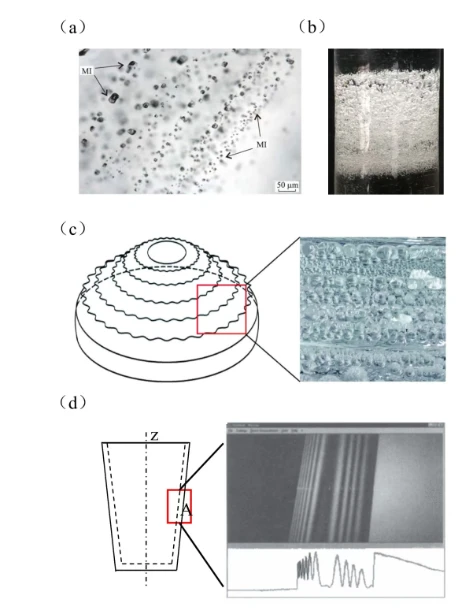
The macroscopic defects of quartz glass mainly include bubbles, inclusions, stripes and cracks, etc. These defects usually occur due to insufficient purity of the raw materials or improper preparation process. The viscosity of quartz in the molten state is high, and the internal bubbles are difficult to escape by themselves. If the melting process is not strict, there may also be a phenomenon where the internal raw materials have not completely melted before being encapsulated by the already molten quartz on the surface. At the same time, quartz glass is a poor thermal conductor. During the cooling process, the temperature changes at the surface and the interior are inconsistent, forming a large temperature gradient, generating thermal stress, and excessive thermal stress may even cause local cracking. Reducing various defects inside quartz glass and ensuring its excellent optical properties is of crucial importance.
In the process of preparing quartz glass by the indirect CVD method, on the one hand, high-purity silicon-containing compounds are used to reduce the content of metal impurities. On the other hand, sintering is employed for dehydroxylation, effectively reducing the hydroxyl concentration of quartz glass, making it more superior in deep ultraviolet transmission performance, with a higher threshold for laser damage resistance, and further enhancing its optical properties.

However, when quartz glass is heated at high temperatures and then cooled to room temperature, thermal stress is generated, and the uneven internal stress will have a significant impact on the optical properties of the product. The uneven distribution of stress will cause the refractive index of different regions of quartz glass to change, resulting in changes in the optical path and light intensity of the light passing through the quartz glass, generating uneven refraction and scattering, and reducing the optical uniformity of the product. At the same time, the stress-induced birefringence effect will cause the wavefront of the light beam to be distorted. In high-power laser devices, the distortion of the wavefront will directly affect the stability of the laser beam, and the internal stress may also lead to a decrease in the laser damage resistance of quartz glass, reducing its service life and reliability.
For optical waveguide devices such as array waveguide gratings, lasers, tunable filters, etc., stress birefringence is also an issue that cannot be ignored. Due to the stress birefringence effect, the propagation characteristics of light are changed, causing polarization shift and polarization-dependent loss. The stressed area may even change the mode shape of the optical waveguide device, seriously affecting the performance and stability of the device.
By controlling the stress within quartz glass,our company can avoid the generation of serious defects such as cracking, ensuring its excellent optical properties, thereby improving the yield and reliability of quartz glass, and enabling it to meet the needs of various optical applications and play an important role in industrial applications


