

-
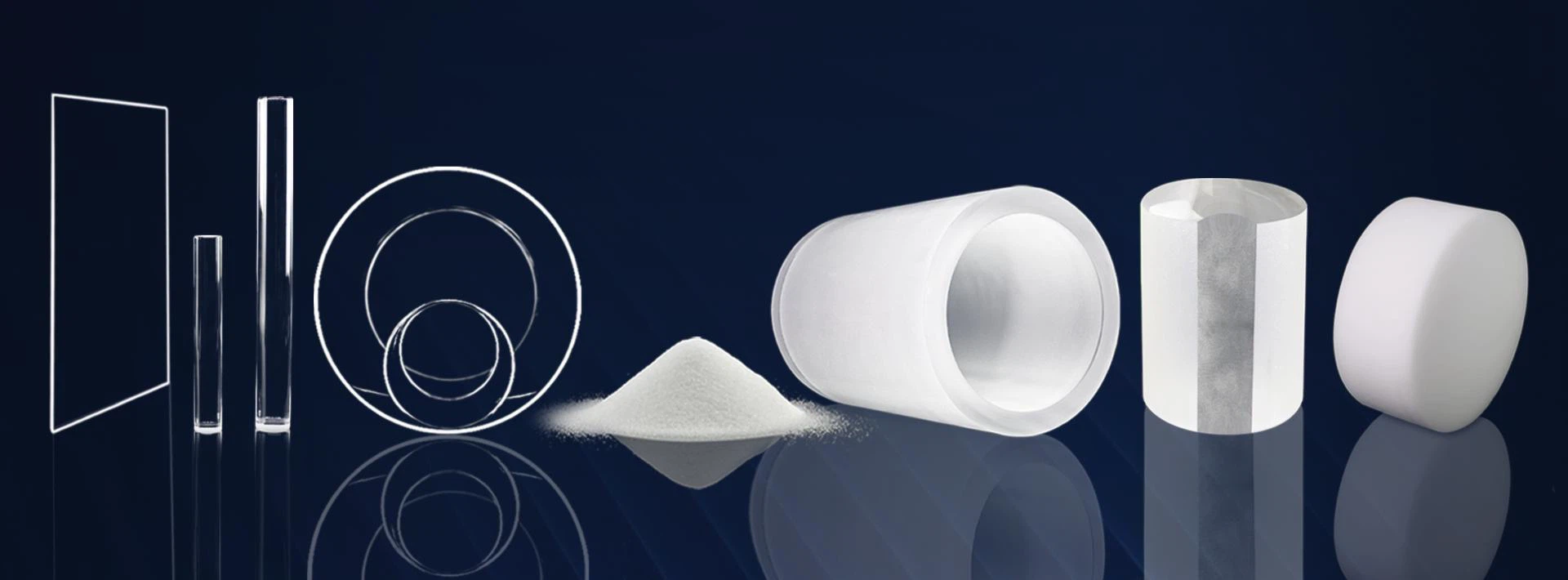
![Semiconductor Grade Quartz Plate]() Semiconductor Grade Quartz PlateSemiconductor grade quartz plates are widely used for industry and science for its optical and mechanical properties.view more
Semiconductor Grade Quartz PlateSemiconductor grade quartz plates are widely used for industry and science for its optical and mechanical properties.view more -
![Semiconductor Grade Opaque Quartz Ingot]() Semiconductor Grade Opaque Quartz IngotSemiconductor grade opaque quartz ingot is a kind of basic material of thermal insulation quartz components.view more
Semiconductor Grade Opaque Quartz IngotSemiconductor grade opaque quartz ingot is a kind of basic material of thermal insulation quartz components.view more -
![Composite Quartz Material]() Composite Quartz MaterialAs thermal insulation material,this new composite quartz glass is used in wafer manufacturing process.view more
Composite Quartz MaterialAs thermal insulation material,this new composite quartz glass is used in wafer manufacturing process.view more -
![High Purity White Opaque Quartz Material]() High Purity White Opaque Quartz MaterialThis high purity white opaque quartz material is mainly used in the field of heat blocking,especially at semiconductor and photovoltaic industries,and is an indispensable component in the semiconductor manufacturing devices.view more
High Purity White Opaque Quartz MaterialThis high purity white opaque quartz material is mainly used in the field of heat blocking,especially at semiconductor and photovoltaic industries,and is an indispensable component in the semiconductor manufacturing devices.view more -
![High Purity Black Opaque Quartz Material]() High Purity Black Opaque Quartz MaterialHigh purity black opaque quartz material can be used in thermal management of semiconductor and photovoltaic silicon wafer manufacturing process.view more
High Purity Black Opaque Quartz MaterialHigh purity black opaque quartz material can be used in thermal management of semiconductor and photovoltaic silicon wafer manufacturing process.view more -
![LPCVD Diffusion Quartz Tube]() LPCVD Diffusion Quartz TubeLPCVD Diffusion Quartz Tube can be used in semiconductor LPCVD to make gaseous compounds react and deposit on the substrate surface to form stable solid films under low pressure by heating.view more
LPCVD Diffusion Quartz TubeLPCVD Diffusion Quartz Tube can be used in semiconductor LPCVD to make gaseous compounds react and deposit on the substrate surface to form stable solid films under low pressure by heating.view more -
![Semiconductor Wafer Boat]() Semiconductor Wafer BoatSemiconductor wafer boat is used in the field of thermal oxidation and diffusion of semiconductor wafer.view more
Semiconductor Wafer BoatSemiconductor wafer boat is used in the field of thermal oxidation and diffusion of semiconductor wafer.view more -
![SIC Silicon Carbide Outer And Liner Quartz Tube]() SIC Silicon Carbide Outer And Liner Quartz TubeSIC Quartz Tube is widely used in the crystal growth furnace, such as 8-12-inch semiconductor grade silicon single crystal furnace, 6-8-inch silicon carbide, gallium arsenide and other semiconductor materials long crystal equipment and...view more
SIC Silicon Carbide Outer And Liner Quartz TubeSIC Quartz Tube is widely used in the crystal growth furnace, such as 8-12-inch semiconductor grade silicon single crystal furnace, 6-8-inch silicon carbide, gallium arsenide and other semiconductor materials long crystal equipment and...view more -
![Quartz Ingot PQ871E]() Quartz Ingot PQ871EIt is produced with high purity quartz sand by oxy-hydrogen flame fusion process. It is applied as basic high quality quartz material in semiconductor applications.view more
Quartz Ingot PQ871EIt is produced with high purity quartz sand by oxy-hydrogen flame fusion process. It is applied as basic high quality quartz material in semiconductor applications.view more -
![Semiconductor Flame Fused Quartz Ingot]() Semiconductor Flame Fused Quartz IngotIt is produced with high purity quartz sand by oxy-hydrogen flame fusion process. It is applied as basic high quality quartz material in semiconductor applications.view more
Semiconductor Flame Fused Quartz IngotIt is produced with high purity quartz sand by oxy-hydrogen flame fusion process. It is applied as basic high quality quartz material in semiconductor applications.view more -
![Semiconductor Grade High Purity Quartz Sand]() Semiconductor Grade High Purity Quartz SandSemiconductor grade high purity quartz is used to produce standard and high purity semiconductor quartz (resized) tube and quartz rod, which is also the raw material of UHP quartz tube.view more
Semiconductor Grade High Purity Quartz SandSemiconductor grade high purity quartz is used to produce standard and high purity semiconductor quartz (resized) tube and quartz rod, which is also the raw material of UHP quartz tube.view more -
![Semiconductor Grade Opaque Quartz Ingot]() Semiconductor Grade Opaque Quartz IngotSemiconductor opaque quartz ingot is used as heat insulation material in semiconductor wafer r manufacturing process.view more
Semiconductor Grade Opaque Quartz IngotSemiconductor opaque quartz ingot is used as heat insulation material in semiconductor wafer r manufacturing process.view more


Quality Assurance
We believe in the sustainable development and obtain the certificates of ISO 9001, ISO14001 and OHSAS18001. Pacific Quartz, gathering the industry talents, is leading at R&D capability and cutting-edge technology innovation for new and high-end products.
Experience and expertise
Through the innovative development of more than 30 years, Pacific Quartz, as a national high-tech enterprise, has become the benchmark enterprise in China's quartz material industry.
Quality services
Our team is committed to delivering high-quality services to our clients. We use the latest technologies and tools to ensure that our services exceed your expectations.
Benefits of Quartz Feeder Tube
Thermal Resistance
One of the main advantages of quartz feeder tube is their ability to resist high temperatures. They can withstand extreme thermal conditions without cracking or breaking, making them an ideal choice for applications such as semiconductor manufacturing, heat lamps, and high-temperature processes. Quartz has a melting point of 1650°C, which makes it an excellent choice for use in extreme temperature environments.
Ultraviolet Transparency
Quartz feeder tube also have high levels of transmittance in the UV spectrum. This makes them suitable for use in applications where UV light must pass through the material without being significantly absorbed. For instance, in the manufacturing of electronic components such as LEDs, quartz feeder tube are required to pass the UV light to the substrate, which is essential in the final product.
High Chemical Resistance
Quartz feeder tube offer exceptional resistance to acids, bases, and other corrosive chemicals. This is because they are made of pure silicon dioxide, which makes them a good candidate where harsh chemicals are involved. This feature is particularly useful in chemical processing industries, where equipment is exposed to extreme corrosive environments.
Great Electrical Insulation Properties
Quartz is an excellent electrical insulator, a quality that makes it perfect for use in various electrical applications such as sensor manufacturing, cables, and other electronic devices. It can withstand high voltage without any electrical breakdowns, thereby making it a safe choice in such applications.
Low Thermal Expansion
Quartz glass tube also have a low coefficient of thermal expansion, which means they can contract and expand without cracking or breaking, even under extreme temperatures. This feature is useful in various industrial applications such as temperature measuring devices, which require unmatched accuracy and stability.

High-Purity Quartz Sand
The primary raw material for quartz feeder tubes is high-purity quartz sand, also known as silica sand. This sand must have low levels of impurities to ensure the final product's purity and performance. The sand is processed to remove contaminants and achieve the desired particle size.
Additives
In some cases, additives are introduced to enhance specific properties of the quartz glass, such as improving its UV transmission or increasing its mechanical strength. These additives must be carefully controlled to maintain the glass's overall quality.
Manufacturing Process Of Quartz Feeder Tube
There are several methods for manufacturing quartz feeder tube, each with its advantages and applications. The most common methods include flame fusion, electric fusion, and chemical vapor deposition (CVD).
Flame fusion, also known as Verneuil process, involves melting high-purity quartz sand using an oxy-hydrogen flame. The molten quartz is then shaped into tubes using rotating mandrels. This method is cost-effective and suitable for producing large volumes of standard quartz feeder tube.
Steps in Flame Fusion Process:
Feeding the Quartz Sand: High-purity quartz sand is fed into the oxy-hydrogen flame, where it melts.
Forming the Tube: The molten quartz is deposited onto a rotating mandrel, forming a cylindrical shape.
Cooling and Annealing: The formed tube is gradually cooled and annealed to relieve internal stresses and improve mechanical strength.
Finishing: The tube is cut to the desired length and undergoes surface treatments if necessary.
Electric fusion involves melting quartz sand using an electric arc. This process is suitable for producing high-purity quartz feeder tube required for critical applications, such as semiconductor manufacturing.
Steps in Electric Fusion Process:
Loading the Quartz Sand: High-purity quartz sand is placed in an electric arc furnace.
Melting: The electric arc generates intense heat, melting the quartz sand.
Forming the Tube: The molten quartz is drawn into tubes using a mandrel or extrusion process.
Cooling and Annealing: The tubes are cooled slowly and annealed to ensure uniformity and strength.
Finishing: The tubes are cut, polished, and inspected for quality.
CVD is a high-precision method used to produce quartz feeder tube with exceptional purity and uniformity. This process is ideal for applications requiring the highest quality, such as optical fibers and advanced scientific instruments.
Steps in CVD Process:
Precursor Gas Introduction: Silicon-containing precursor gases are introduced into a reactor chamber.
Decomposition: The gases decompose at high temperatures, depositing a layer of silicon dioxide on a substrate.
Layer Formation: Multiple layers are deposited to achieve the desired tube thickness.
Cooling and Annealing: The tubes are carefully cooled and annealed to eliminate internal stresses.
Finishing: The tubes are cut, polished, and subjected to rigorous quality control tests.
Quartz Heat-Treated Tube
Quartz heat-treated tube are primarily used as reaction chambers and sample holders in laboratory tube furnaces. When coming with flanges the quarts tube provide a controlled environment for heat treatment processes such as annealing, sintering, calcination, and thermal decomposition.

Benefits of Quartz Heat-Treated Tube
High Thermal Stability: Quartz heat-treated tubes exhibit exceptional thermal stability, capable of withstanding temperatures exceeding 1000°C without deformation or degradation. This property makes them ideal for applications requiring intense heating cycles and rapid temperature changes.
Infrared Transmission: Quartz is transparent to infrared radiation, allowing quartz heat-treated tubes to efficiently transmit heat through radiation. This characteristic ensures energy-efficient heating and precise thermal management in various processes.
Chemical Inertness: Quartz is chemically inert, resisting reactions with most acids, alkalis, and other chemicals. This inertness ensures that quartz heat-treated tubes maintain purity and do not contaminate sensitive processes, such as semiconductor fabrication.
Mechanical Strength: Despite its delicate appearance, quartz exhibits high mechanical strength and durability. Quartz heat-treated tubes can withstand mechanical stress and thermal shock, ensuring prolonged operational reliability in demanding environments.
Manufacturing Of Quartz Heat-Treated Tube
Raw material selection
The first step in the manufacturing process of quartz heat-treated tube is the selection of high-quality raw materials. High-purity quartz sand is typically used as the main raw material. The quality of the quartz sand plays a critical role in the final properties of the quartz heat-treated tube. The sand is carefully selected based on its purity, particle size distribution, and other properties to ensure high-quality quartz heat-treated tube production.
Quartz heat-treated tube melting
Once the raw materials are selected, the quartz heat-treated tube melting process begins. The raw materials are melted in a high-temperature furnace, typically using a process called the flame fusion method or the electric arc melting method. The temperature is carefully controlled to melt the quartz sand into a homogenous liquid state. Various additives may be used during the melting process to control the properties of the final quartz heat-treated tube, such as the refractive index, viscosity, and thermal properties.
Forming and shaping
After the quartz heat-treated tube is melted, it is then formed and shaped into the desired final product. This can be achieved through various techniques, such as casting, blowing, drawing, or pressing. The forming and shaping process is carefully controlled to ensure uniformity in the thickness, shape, and dimensions of the quartz heat-treated tube.
Annealing
Once the quartz heat-treated tube is formed and shaped, it undergoes an annealing process to relieve internal stresses and improve its thermal stability. The quartz heat-treated tube is slowly cooled down to room temperature in a controlled manner to prevent cracks, distortions, or other defects from forming due to rapid temperature changes. The annealing process is critical to ensure the mechanical strength and durability of the final quartz heat-treated tube product.
Finishing and polishing
After the annealing process, the quartz heat-treated tube may undergo additional finishing and polishing steps to achieve the desired surface smoothness, optical clarity, and dimensional accuracy. This may involve grinding, lapping, and polishing techniques to remove any surface imperfections and achieve the desired final product specifications.
Quality control
Throughout the entire manufacturing process of quartz heat-treated tube, strict quality control measures are implemented to ensure the highest quality standards are met. This may involve regular testing and inspection of the raw materials, monitoring of the melting process parameters, inspection of the formed and shaped quartz heat-treated tube, and testing of the final product properties. Quality control is crucial to ensure consistent and reliable production of high-quality quartz heat-treated tube materials.
Cleaning
Quartz heat-treated tube products should be cleaned regularly to remove dirt, dust, fingerprints, and other contaminants that may accumulate on the surface. It is recommended to use a gentle cleaning solution specifically designed for quartz heat-treated tube, along with a soft, lint-free cloth or a non-abrasive sponge. Avoid using harsh chemicals, abrasive cleaners, or rough materials that can scratch or damage the surface of the quartz heat-treated tube.
Handling
When handling quartz heat-treated tube products, it is important to exercise caution to prevent dropping, banging, or scratching the glass. Handle the glass with clean hands or wear gloves to avoid leaving fingerprints or oils on the surface. Use appropriate tools, such as padded clamps or soft jaws, when gripping or moving quartz heat-treated tube products to prevent damage or stress on the glass.
Thermal shock
Quartz heat-treated tube has high thermal stability, but extreme temperature changes can cause thermal shock, leading to cracks or fractures. Avoid subjecting quartz heat-treated tube products to rapid temperature changes, such as placing hot objects on a cold quartz heat-treated tube surface or vice versa. Allow the glass to cool or warm up gradually to minimize the risk of thermal shock.
Protection from chemicals
Quartz heat-treated tube is highly resistant to most chemicals, but prolonged exposure to certain aggressive chemicals or acidic solutions can cause etching or damage to the glass surface. Avoid prolonged contact with chemicals, acids, or corrosive substances on quartz heat-treated tube products. If contact occurs, rinse the glass thoroughly with water and mild detergent, and dry it with a soft cloth.
Storage
Proper storage of quartz heat-treated tube products is important to prevent damage or breakage. Store quartz heat-treated tube products in a clean, dry, and dust-free environment to avoid accumulation of dirt or contaminants. Avoid stacking heavy objects on top of quartz heat-treated tube products and use protective covers or padding to prevent scratching or chipping.
Regular inspection
Regularly inspect quartz heat-treated tube products for any signs of damage, cracks, or other defects. If any issues are detected, take immediate action to repair or replace the damaged glass to prevent further damage or compromise the performance of the glass.
Uses of Quartz Heat-Treated Tube
Heating and Annealing: Quartz heat-treated tubes are commonly used as heating elements or containment vessels in high-temperature processes such as annealing, brazing, melting, and soldering of metals, ceramics, and semiconductor materials.
Chemical Processing: Quartz heat-treated tubes find applications in the chemical industry for chemical reactions, distillation, evaporation, and sample containment. They are resistant to corrosive chemicals and high temperatures, making them ideal for harsh chemical environments.
Laboratory Equipment: Quartz heat-treated tubes are used in laboratories for various applications, including quartzware for chemical analysis, sample digestion, atomic absorption spectroscopy (AAS), and other analytical techniques requiring high-purity containers.
UV Sterilization: Quartz heat-treated tubes are used in UV sterilization systems for water purification, air sterilization, and surface disinfection. The transparency of quartz to UV light allows for effective germicidal action.
Optical and Semiconductor Applications: Quartz heat-treated tubes are used in optical instruments, laser systems, semiconductor manufacturing, and photolithography processes due to their optical transparency, thermal stability, and chemical inertness.
Our Factory
Jiangsu Pacific Quartz Co., Ltd. (short as Pacific Quartz hereinafter), founded in 1992, is a company well integrated with R&D, manufacturing and sales of high-end quartz materials. In 2014, Pacific Quartz was listed on the A shares main board of Shanghai Stock Exchange (Stock Ticker: SYGF, SH603688).
Through the innovative development of more than 30 years, Pacific Quartz, as a national high-tech enterprise, has become the benchmark enterprise in China's quartz material industry.


Asked Questions
As one of the most professional quartz for semiconductor application manufacturers and suppliers in China since 1992, we're featured by quality products and good service. Please rest assured to wholesale customized quartz for semiconductor application at competitive price from our factory.
Semiconductor Grade Quartz Tube, fused silica tube, small diameter quartz rod


