

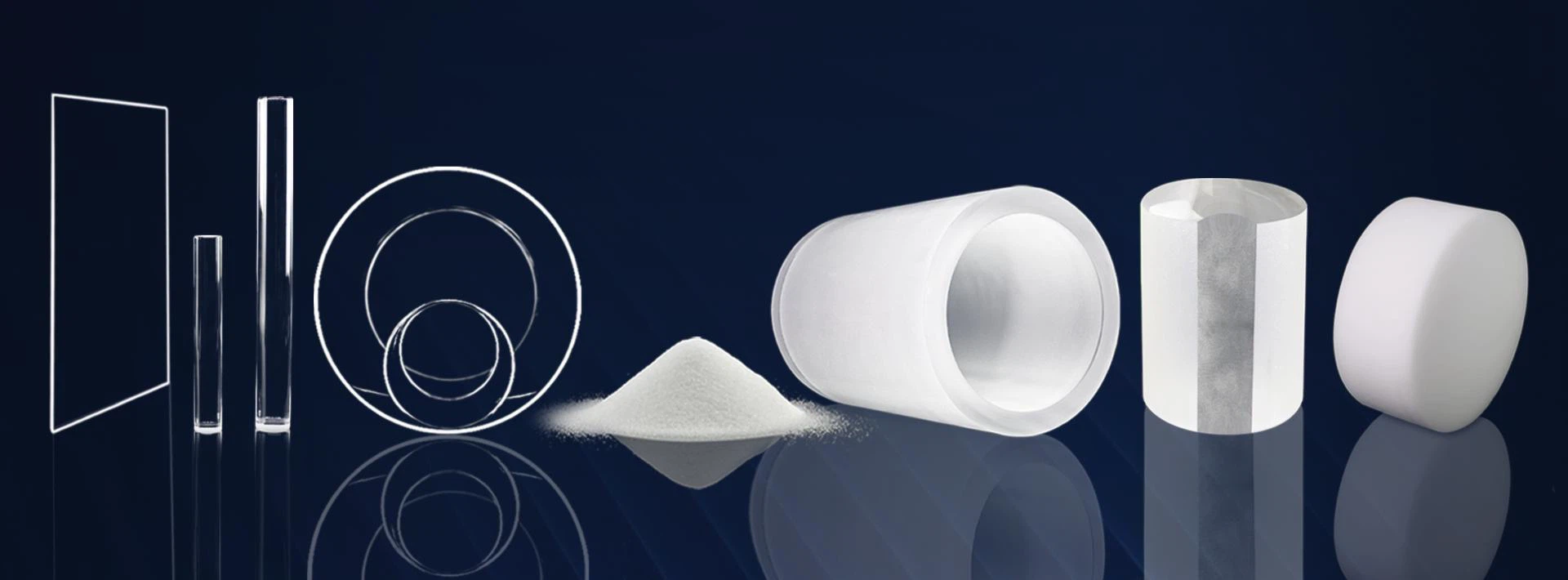

Semiconductor grade quartz plates are widely used for industry and science for its optical and mechanical properties. These properties make it resistant to chemicals, withstand high temperatures and thermal shock. It has a low thermal expansion and high transmission from UV 260nm to over 2 microns.
Benefits of Semiconductor Grade Quartz Plate
Very Low Coefficient of Thermal Expansion
Semiconductor grade quartz plates exhibit an extremely low coefficient of thermal expansion (CTE), typically around 0.55 x 10^-6 /°C. This property ensures minimal dimensional changes with temperature variations, enabling them to withstand rapid temperature fluctuations without cracking or warping.
High-Temperature Resistance
Quartz plates possess exceptional thermal resistance, withstanding temperatures up to 1500°C. This attribute makes them ideal for applications involving high-temperature processes, such as semiconductor fabrication, glassblowing, and chemical reactions.
Optical Clarity
Semiconductor grade quartz plates are characterized by their high optical clarity, allowing for exceptional light transmission. They exhibit minimal absorption and scattering of light, making them suitable for various optical applications, including lenses, prisms, and windows.
High Chemical Purity
Quartz plates are composed of ultra-pure silica (SiO2), resulting in high chemical purity. They are resistant to most acids, bases, and organic solvents, making them ideal for applications in harsh chemical environments.
Excellent Electrical Insulation Qualities
Semiconductor grade quartz plates are excellent electrical insulators, possessing high resistivity and low dielectric loss. This property makes them suitable for electrical applications, such as insulators, capacitors, and high-voltage components.

Applied in silicon wafer diffusion and other heat treatment equipment, to maintain the internal thermal field temperature uniformity and stability, to ensure the quality of silicon wafer processing.


Quartz device used to control the uniform feeding of silicon in the process of drawing monocrystalline silicon, also can be used in semiconductor process.

High Purity White Opaque Quartz Material
This high purity white opaque quartz material is mainly used in the field of heat blocking,especially at semiconductor and photovoltaic industries,and is an indispensable component in the semiconductor manufacturing devices.

Semiconductor Grade Opaque Quartz Ingot
Semiconductor grade opaque quartz ingot is a kind of basic material of thermal insulation quartz components.

As thermal insulation material,this new composite quartz glass is used in wafer manufacturing process.

LPCVD Diffusion Quartz Tube can be used in semiconductor LPCVD to make gaseous compounds react and deposit on the substrate surface to form stable solid films under low pressure by heating.

Semiconductor wafer boat is used in the field of thermal oxidation and diffusion of semiconductor wafer.

SIC Silicon Carbide Outer And Liner Quartz Tube
SIC Quartz Tube is widely used in the crystal growth furnace, such as 8-12-inch semiconductor grade silicon single crystal furnace, 6-8-inch silicon carbide, gallium arsenide and other semiconductor materials long crystal equipment and processes.
Why Choose us
Quality Assurance
We believe in the sustainable development and obtain the certificates of ISO 9001, ISO14001 and OHSAS18001. Pacific Quartz, gathering the industry talents, is leading at R&D capability and cutting-edge technology innovation for new and high-end products.
Experience and expertise
Through the innovative development of more than 30 years, Pacific Quartz, as a national high-tech enterprise, has become the benchmark enterprise in China's quartz material industry.
Quality services
Our team is committed to delivering high-quality services to our clients. We use the latest technologies and tools to ensure that our services exceed your expectations.
Distinguishing Semiconductor Grade Quartz Plate From Glass
Semiconductor grade quartz plate and glass are both composed of silicon dioxide (sio2), but the key difference lies in their chemical composition and molecular structure. Semiconductor grade quartz plate is a crystalline mineral with a highly ordered, symmetrical structure, while glass is an amorphous solid with a random, disordered molecular arrangement. This difference in structure is due to the different formation processes of the two materials. Semiconductor grade quartz plate forms naturally through the crystallization of molten rock, while glass is produced by rapidly cooling molten silica.
The difference in molecular structure between semiconductor grade quartz plate and glass has a significant impact on their physical properties. Semiconductor grade quartz plate crystals have a regular, repeating pattern of atoms, which gives them a high degree of symmetry and strength. Glass, on the other hand, has a more disordered structure, which results in lower symmetry and strength.
The difference in molecular structure between semiconductor grade quartz plate and glass also affects their optical properties. Semiconductor grade quartz plate is birefringent, meaning that it splits light into two polarized rays. This property makes semiconductor grade quartz plate useful for optical applications such as polarizers, lenses, and prisms. Glass, on the other hand, is isotropic, meaning that it transmits light equally in all directions. This property makes glass useful for applications such as windows, bottles, and containers.
Lithography: Lithography is a fundamental process in semiconductor manufacturing that involves transferring intricate patterns onto the semiconductor wafer. Semiconductor grade quartz plate find application in lithography as photomasks or reticles. These plates act as a substrate for the patterned masks to project the desired pattern onto the photoresist-coated wafer. The high optical transparency and thermal stability of semiconductor grade quartz plate make them ideal for ensuring accurate pattern transfer during lithography.
Etching: Etching is crucial in defining the circuitry on a semiconductor wafer. Semiconductor grade quartz plate are used as etch masks to protect certain wafer areas during the etching process. Their resistance to various etchants and plasma environments allows precise and controlled removal of unwanted material, resulting in well-defined patterns and structures.
Deposition: Deposition processes add layers of materials onto the semiconductor wafer. Semiconductor grade quartz plate act as substrates for thin-film deposition techniques such as physical vapor deposition, known as (pvd) and chemical vapor deposition (cvd). Their excellent thermal stability and compatibility with high-temperature processes make them ideal for ensuring uniform film growth and adhesion.
Annealing and thermal processing: Thermal processing steps, such as annealing, are crucial for activating dopants, repairing crystal defects, and improving material properties. Semiconductor grade quartz plate serve as a platform for wafers during these thermal processes. Their high thermal conductivity and resistance to thermal shock enable efficient heat transfer and uniform temperature distribution, ensuring the desired outcomes of the thermal processing steps.
Wafer handling and carriers: Throughout the semiconductor manufacturing workflow, semiconductor grade quartz plate are used as carriers for wafers, providing mechanical support and protection during transportation between process steps. Quartz carriers are known for their dimensional stability, cleanliness, and chemical inertness, ensuring the integrity and cleanliness of the wafers.
Production of semiconductor grade quartz plate
Raw materials and cleaning
The starting material for this process is pure silicon dioxide (sio2), which can be available in various forms, such as natural quartz sand or synthetic silicon dioxide.
The first step in the production of semiconductor grade quartz plate is the selection and purification of the raw materials. To ensure high purity, only the purest forms of silicon dioxide are used.
This raw material is then thoroughly cleaned to remove any impurities that could affect the properties of the finished semiconductor grade quartz plate.
Melting process
The melting process is a crucial step in the production of semiconductor grade quartz plate. There are several methods of melting silicon dioxide, but the most common processes are electric melting and flame hydrolysis.
Electric melting
In this process, silicon dioxide is melted in an electrically heated furnace at extremely high temperatures (over 2000 degrees celsius). The resulting melt then flows out of the crucible through a lower mold, in which the material is subsequently shaped into tubes, plates or rods.
Flame hydrolysis process
In this process, silicon tetrachloride (sicl4) is fed into a flame, where it oxidizes at high temperatures and burns into fine silicon dioxide particles. These particles form a solid block, which is then processed further.
Shaping and finishing
After the semiconductor grade quartz plate has been melted and shaped, the post-processing takes place. This process involves cooling and relaxing the semiconductor grade quartz plate and subsequent mechanical treatment in order to achieve the desired properties and the required precision.
Applications Of Semiconductor Grade Quartz Plate In Various Industries
Eyeglasses: Semiconductor grade quartz plate is used in the production of high-quality eyeglasses due to its excellent optical properties, providing clear and distortion-free vision.
Self-cleaning windows: Quartz-coated windows repel dirt and water, reducing the need for cleaning and maintenance. They are commonly used in skylights, skyscrapers, and other high-rise buildings.
Solar energy: Semiconductor grade quartz plate is a crucial component in solar cells, converting sunlight into electricity. Its high transparency and low thermal expansion coefficient make it an ideal material for solar panels.
Computer chips: Semiconductor grade quartz plate is used as a substrate for semiconductor wafers, providing a stable and durable base for electronic circuits.
Displays: Semiconductor grade quartz plate is employed in liquid crystal displays (lcds) and organic light-emitting diodes (oleds), ensuring high image quality and durability.
Communications: Semiconductor grade quartz plate is used in optical fibers for high-speed data transmission due to its low optical loss and wide bandwidth.
Protective films: Quartz-based coatings provide scratch resistance and durability to various surfaces, such as glass, metal, and plastics.
Plating: Quartz is used in electroplating processes to create decorative and protective finishes on metals, enhancing their appearance and resistance to corrosion.
Laboratory equipment: Semiconductor grade quartz plate test tubes, beakers, and other laboratory glassware are commonly used in scientific research and analysis due to their chemical inertness and high thermal stability.
Semiconductors: Quartz is employed in the manufacturing of semiconductors, providing a precise and controlled environment for the fabrication of electronic devices.
Sight gages: Semiconductor grade quartz plate is used in sight gages to monitor liquid levels in tanks and pipelines, ensuring accurate and reliable measurements.
Optics: Quartz is utilized in optical components, such as lenses, prisms, and mirrors, due to its high optical clarity and low refractive index.
Pharmaceutical and industrial processes: Semiconductor grade quartz plate is used in pharmaceutical and industrial processes, including uv disinfection, chemical etching, and high-temperature applications.
Our Factory
Jiangsu Pacific Quartz Co., Ltd. (short as Pacific Quartz hereinafter), founded in 1992, is a company well integrated with R&D, manufacturing and sales of high-end quartz materials. In 2014, Pacific Quartz was listed on the A shares main board of Shanghai Stock Exchange (Stock Ticker: SYGF, SH603688).
Through the innovative development of more than 30 years, Pacific Quartz, as a national high-tech enterprise, has become the benchmark enterprise in China's quartz material industry.


Asked Questions
Hot Tags: semiconductor grade quartz plate, China, suppliers, manufacturers, factory, customized, wholesale, quartz sleeving, Opaque Quartz Flange, super high purity quartz glass tube, Semiconductor Grade Opaque Quartz Ingot, large diameter curtain pole, Semiconductor Outer Quartz Tube


